Your Feed Is a Mirror, Not a Window—And Your Community Is Paying for It

There's a specific kind of weird that happens when you show up to a local meetup, a Discord server's voice chat, or even just a thread you've been lurking for months—and realize everyone's been talking about something you've never heard of. Not because you were out of the loop. But because your loop was just... different. Same community. Completely different experience.
That's not a glitch. That's the algorithm doing exactly what it was designed to do.
The Feed That Knows You Too Well
Personalization tech has gotten genuinely impressive in the last few years. Platforms have moved well past "you liked this, so here's more of this" into something closer to predictive taste modeling. Spotify doesn't just recommend songs—it constructs an entire sonic identity for you. TikTok doesn't show you content from your community; it shows you the slice of your community that its model believes you'll engage with longest. Reddit, YouTube, even niche forums with algorithmic sorting—they're all doing a version of the same thing.
On the surface, that sounds like a win. You're not wading through stuff that doesn't interest you. You're getting the signal without the noise.
But here's the thing about filtering out the noise: sometimes the noise is the culture.
The weird, off-topic tangent in a forum thread. The artist your scene is arguing about because half of them hate the new direction. The meme format that's already dead by the time it reaches you because the algorithm decided you weren't the target demographic for it. These aren't distractions from community—they're the texture of it. And when a platform smooths all of that out in service of your "preferences," what you're left with is a highly personalized experience that feels like community without actually functioning like one.
Everyone's Experiencing a Different Version of the Same Space
Let's make this concrete. Imagine two people who are both deeply embedded in the same niche music subculture—let's say experimental electronic. One of them engages mostly with production discussions, gear talk, and technical breakdowns. The other is more drawn to the cultural criticism side: think-pieces, interviews, discourse about where the genre is headed.
On a platform with strong algorithmic curation, these two people are essentially living in parallel versions of the same community. They share an identity label. They might even follow each other. But the content ecosystem each of them inhabits has been so specifically tailored that they have almost no overlapping reference points. When they finally do interact, there's this odd friction—like two people who grew up in the same town but went to different schools, listened to different radio stations, and somehow never crossed paths until now.
Multiply that across thousands of community members and you don't have a community anymore. You have a collection of micro-audiences who've been sorted into adjacent pods and handed the same membership card.
The Discovery Problem Nobody Wants to Talk About
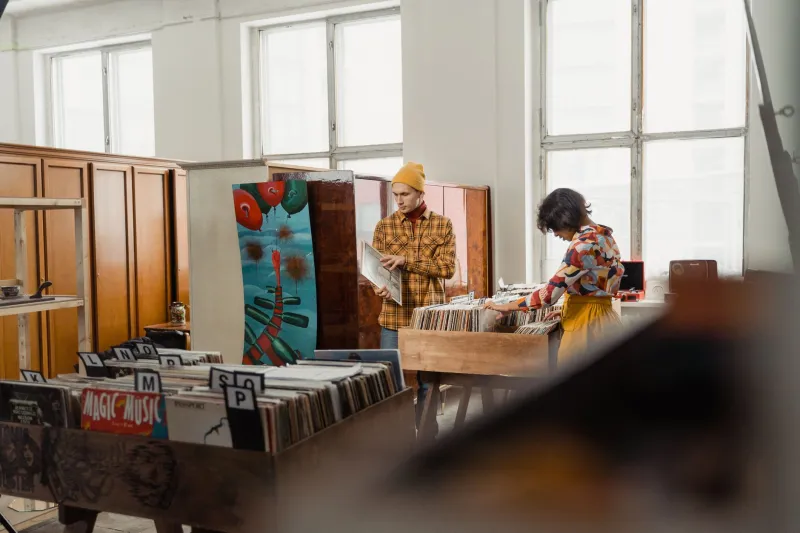
One of the original promises of online community—especially in subculture spaces—was discovery. You'd fall into a forum or a message board or an IRC channel and get exposed to things you didn't know you needed. Someone would post something completely outside your wheelhouse and you'd follow that thread and come out the other side with a new artist, a new idea, a new way of thinking about the thing you already loved.
Algorithms have made that kind of sideways discovery increasingly rare. Not impossible, but rare—and increasingly dependent on whether the platform's engagement model happens to reward that kind of content.
The irony is that the more sophisticated the curation gets, the more it tends to reinforce what you already think, already like, already believe. It's not expanding your taste within your subculture—it's excavating deeper into the specific corner of it you already occupy. You get more, but you get more of the same. And over time, that sameness starts to feel like the whole picture.
For communities built around identity—musical subcultures, hobby spaces, political niches, whatever your scene is—this matters a lot. Shared references are social infrastructure. Inside jokes, collective reactions to big moments, the experience of everyone losing their minds about the same thing at the same time—these are the things that create the feeling of we. When the algorithm fragments that into a thousand personalized experiences, the we starts to hollow out.
So What Do We Actually Do About It
This isn't really a call to delete your apps or rage-quit your streaming service. That's not realistic, and honestly, the convenience these platforms provide is real. The curation tools that make spaces like FilteredFreq function—the ability to find your people, filter the content that matters, dial into what's relevant—that stuff has genuine value.
But it's worth being intentional about the ways you move through curated spaces.
Seek out the unfiltered version of your community sometimes. Go to the chronological feed if the platform offers it. Read threads you wouldn't normally click. Engage with the person in your Discord who's always posting about the aspect of the scene you know nothing about. Follow the recommendation from a human being you trust, even if it doesn't match your algorithmic profile.
And maybe most importantly: notice when your experience of a community starts to feel suspiciously frictionless. Real communities have friction. They have disagreements and tangents and content that isn't optimized for your retention. If everything you're seeing feels perfectly calibrated to your taste, that's not a sign the community is healthy—it's a sign the algorithm has done its job a little too well.
The Signal Worth Protecting
There's a reason the FilteredFreq ethos centers community first—not content, not curation, not the cleanest possible feed. Community is the thing that survives platform changes, algorithm updates, and the inevitable moment when the app you built your scene around decides to pivot to video or whatever comes next.
But community requires actual contact. Not just shared identity, but shared experience. And shared experience is hard to manufacture when everyone's been handed a different version of the same reality.
The algorithm knows your taste better than your friends do. That's not a feature. That's the problem. Your friends can surprise you. Your friends can be wrong in ways that teach you something. Your friends can introduce you to the one track, the one idea, the one conversation that completely reframes how you think about the thing you love.
No model trained on your engagement history is going to do that for you.
Dial back in. Talk to the actual people. Let the feed get a little messy.